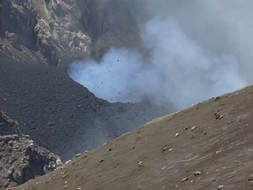
 Rapid strombolian activity at Mt. Etna in July 2012. Rapid strombolian activity at Mt. Etna in July 2012. The above is probably what I wish I had called one of my recently published papers, which have looked at the behaviour of large gas bubbles which ascend and burst at the surface (I'll make an amusing title a future career goal...). To understand more about the eruptions we see at the surface we have to investigate what we can't see below the surface and then try and make links between the two. A lot of my work has focused on one style of behaviour in particular, that of strombolian explosions. Strombolian explosions are likely driven by large gas bubbles which we call Taylor bubbles or gas slugs, named after one of the authors in the following paper (Davies and Taylor, 1950). The archetypal location for strombolian activity is on the island of Stromboli, but similar styles of activity also occur at other locations. A lot of work has been put into understanding the dynamics of single Taylor bubbles ascending in conduits, however, far less has been done for multiple Taylor bubbles ascending in close proximity and which may interact during ascent. This is what my recent paper "The dynamics of slug trains in volcanic conduits: evidence for expansion driven coalescence" begins to investigate through the use of analogue experiments (see video below for 30 s clips of the experiments which were shot using super-slow-motion cameras). These experiments were inspired somewhat by activity I observed and investigated in 2012 within the Bocca Nuova crater of Mt Etna. In particular, we were interested in the ability for individual Taylor bubbles to interact and join together during coalescence, and how this may have affected the distribution of each bubble. For more information on this work see the paper here, which is open access! The other paper published "Combining Spherical-Cap and Taylor Bubble Fluid Dynamics with Plume Measurements to Characterize Basaltic Degassing" involved the construction and illustration of a brand new model which describes the styles of activity we see at volcanoes such as Stromboli based on the ability of bubbles to interact and the time separating each individual burst at the surface. The aim of this paper is to bring together observations of gas emissions and explosive activity at the surface with the behaviour of bubbles as they ascend in the conduit at depth. This paper can be found here, and is also open access. |
  Archives
July 2023
|
 RSS Feed