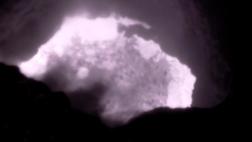
 Masaya lava lake captured using thermal imagery. The collapse of a portion of the wall can be seen in the top right. Masaya lava lake captured using thermal imagery. The collapse of a portion of the wall can be seen in the top right. Three days of (hopefully!) successful fieldwork under our belts and already we have managed to tick off a few of our goals of our list with four days of fieldwork left to go. We have had plenty of opportunity to get access to the summit area to measure the lava lake using our thermal camera and we had a pretty cool surprise when I processed some of the data in the evening. We discovered footage of a partial collapse of the lava lake wall into the lake (right), which I am sure I will post footage of soon. The lava lake really is mesmerising, it can be quite hard to tear yourself away from it, my brain trying to delve into some of the processes which appear to be going on. 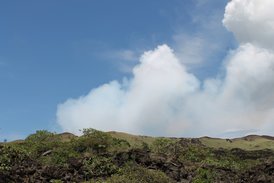 The plume at Masaya. The plume at Masaya. We have also conducted a fair bit of gas remote sensing of the plume (left) using our ultra violet (UV) cameras and have tested our spectrometer as well which are both designed for the measurement of sulphur dioxide (SO2) which this volcano appears to throw out in abundance. Something has to keep the lava lake vigorously over-turning! Masaya is actually quite a difficult location to find a good spot to measure the gas plume. Its low elevation means that the plume quite frequently hugs the ground, which isn't ideal for our measurements as it's best if we have clear sky on either side. Anyway we think we got a clear vantage point. So something I haven't spoken about yet is that the funding for this trip was helped by something called the GLOSS (Global Learning Opportunities in the Social Sciences) scheme at the University of Sheffield. This provides undergraduates the chance to work with academics on a research project. A truly fantastic opportunity, which I would have loved as an undergraduate! Some of the skills, whilst a lot to take on board in one go, e.g., how the equipment works, the protocols for measurement, and the 'fieldwork' aspect, are not covered in as much detail in a degree. For me, after a year of predominantly teaching, it has been great to be as research intensive as possible during this trip (bar a few admin duties). In short, a thoroughly enjoyable experience! Now off to the field for the day. Comments are closed.
|
  Archives
July 2023
|
 RSS Feed